The history
Cartagena's pirates and its walls
How Cartagena became a target for pirates and then a fortress: the raids from 1544 to 1697, Drake in 1586, the walls and the siege of 1741, in order.
Book the pirate ship ↗Quick answer
Cartagena was founded in 1533 and soon became a rich port, because silver from Potosí left from it for Spain. Raiders followed: French pirates in 1544 and 1569, and Francis Drake in April 1586. Spain answered with walls and forts, which UNESCO calls the most extensive system of military fortifications in South America, and which held against the British siege of 1741.
A port for silver
Pedro de Heredia founded Cartagena on 1 June 1533. Its port soon mattered to the whole Spanish empire, because the Tierra Firme fleet, the galleons, sailed here to load South American goods, above all silver from Potosí, before both treasure fleets met at Havana for the voyage back to Spain. A harbour holding that much value was an obvious target for pirates and corsairs, encouraged by France, England and Holland. The pirate theme starts from that fact.
1544: the first big raid
In 1544 French pirates pillaged Cartagena with five ships and 1,000 men. They took advantage of the fact that the city still had no walls, and Heredia was forced to retreat to Turbaco until a ransom was paid. In 1566 Governor Anton Dávalos built a defensive tower, San Felipe del Boquerón, to protect the anchorage, but its battery had limited range.
1568 and 1569: Hawkins and Cote
In 1568 Sir John Hawkins asked the governor to open a trade fair, which Spanish law forbade with foreigners. Many in the settlement suspected it would let his men sack the port afterwards, so the governor refused. Hawkins bombarded the city for eight days and withdrew without making a significant impact. In 1569 the French pirate Martin Cote struck with 1,000 men and ransacked the city. A few months later a fire destroyed it, and the city created a firefighting squad, the first in the Americas. Raids and disasters came close together.
April 1586: Drake
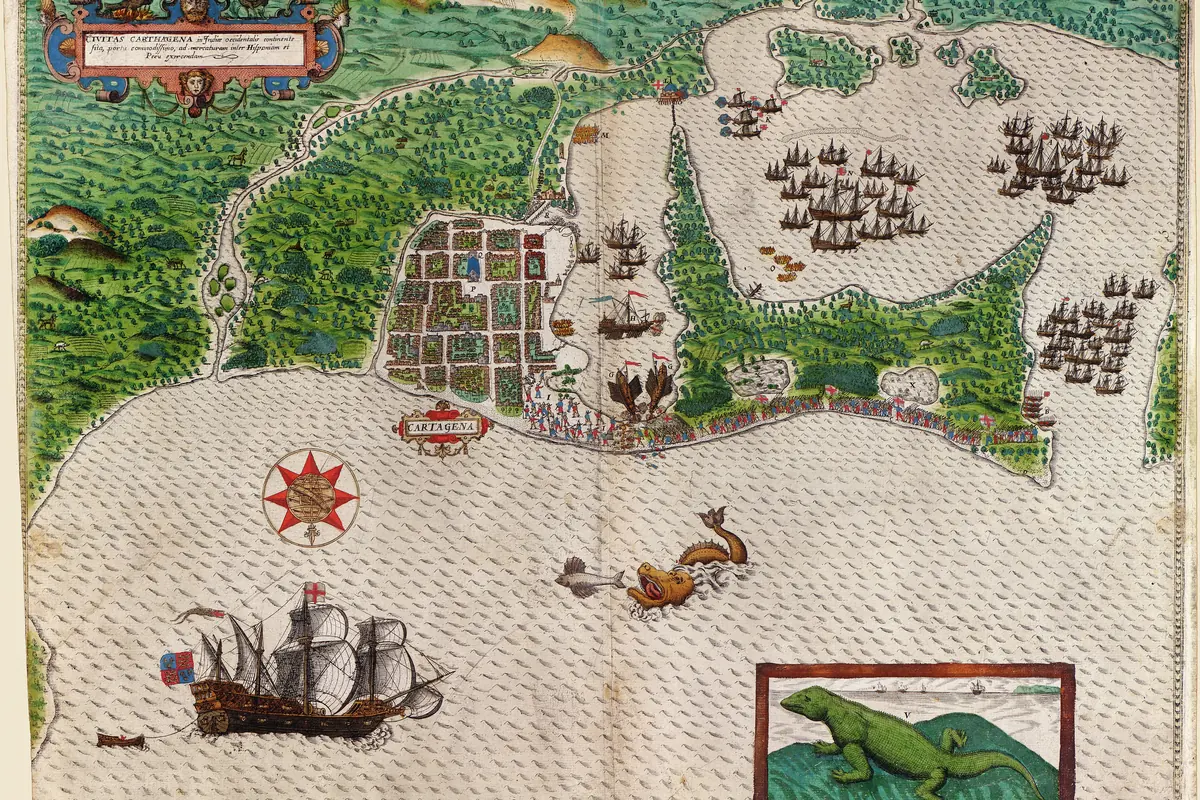
Francis Drake attacked in April 1586 with 23 ships and 3,000 men. He burned 200 houses and the cathedral, and he left only after a ransom was paid a month later. An engraving by Baptista Boazio shows his fleet in the bay. Spain's answer came the same year: the crown commissioned an engineer to design a scheme for defending its Caribbean ports.
The walls begin
Spain commissioned the Italian engineer Bautista Antonelli in 1586 to design a master scheme for defending its Caribbean ports, and he returned to Cartagena in 1594 with plans for a walled city. UNESCO dates the first Spanish defensive fortifications here to 1586, and says they were strengthened and extended to their current dimensions in the 18th century. Construction continued for about two hundred years. Governor Francisco de Murga also enclosed Getsemaní with walls from 1631. The stone you see from the bay is the result of that long project.
Read next: Forts you see from Cartagena Bay
1697: Pointis returns
In April 1697 the Baron de Pointis and Jean Baptiste Ducasse attacked again. Pointis brought 22 large ships, 500 cannon and 4,000 troops, and Ducasse brought 7 ships and 1,200 buccaneers. They overwhelmed the fort of San Luis at Bocachica, and then the Castillo San Felipe de Barajas also fell. The city came under bombardment, the Half Moon Gate was breached and the governor capitulated. The Baron left after a month of plunder. The defences were extended in the 18th century.
1741: the siege that failed
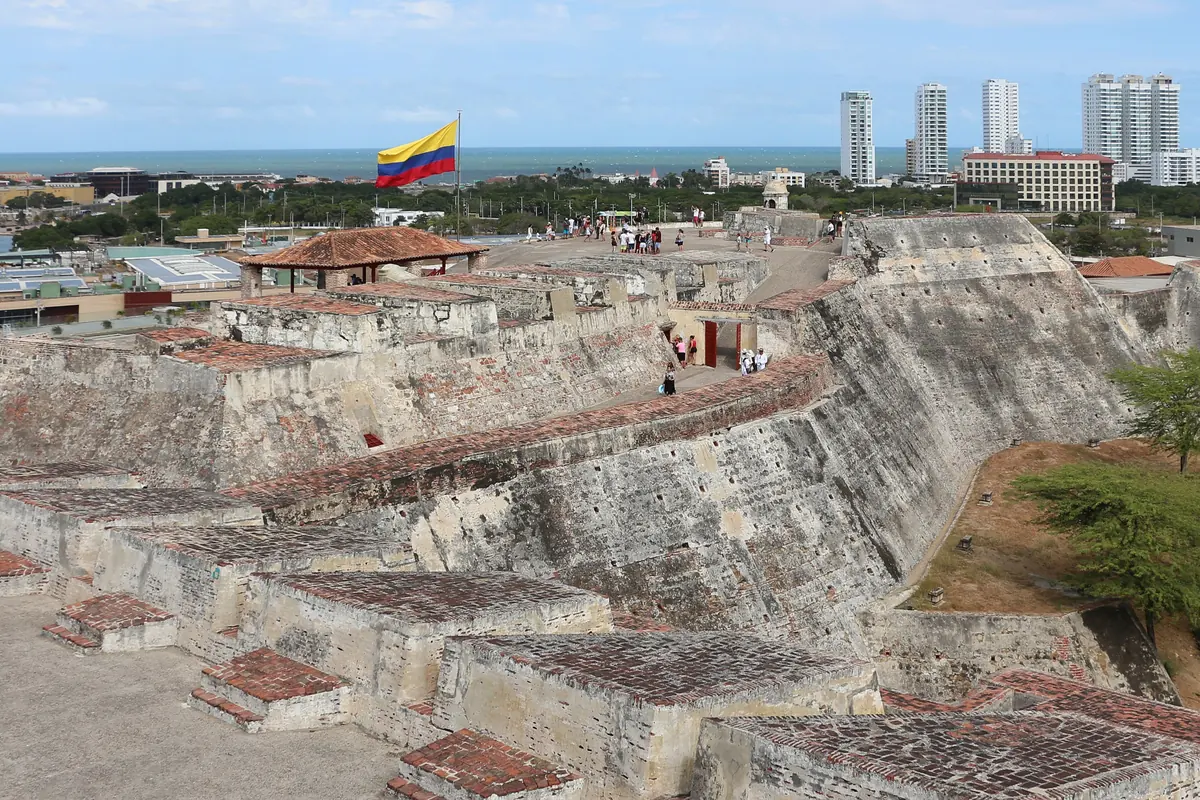
In mid-April 1741 a British armada under Admiral Edward Vernon besieged the city. It had 50 warships, 130 transport ships and 25,600 men. The British took the Castillo de San Luis at Bocachica, but a failed attack on San Felipe de Barajas on 20 April 1741 led Vernon to lift the siege. The Spanish defence was under Sebastián de Eslava and Blas de Lezo, and disease weakened the British force badly.
What the cruise adds
The cruise does not teach this history, and the cannon show is entertainment. Its value is the setting: you sail the bay these fleets fought over, with the fortifications UNESCO lists as a World Heritage property in view. Cartagena's port, fortresses and group of monuments were inscribed in 1984. A pirate evening here is a light way into a serious story, and anyone who wants the story in full can walk the walls by day.
Read next: Cartagena pirate ship: which to book
Frequently asked questions
When did Drake attack Cartagena?
In April 1586, with 23 ships and 3,000 men. He burned 200 houses and the cathedral and left after a ransom was paid a month later.
Why were there walls?
Raids showed the city's weakness. Spain commissioned Bautista Antonelli in 1586 to design defences, and building continued for about two hundred years.
Did the British ever take Cartagena?
Not in 1741. Admiral Vernon lifted the siege after a failed attack on San Felipe de Barajas on 20 April.
Sources